Showing posts with label How To Be Vegan In Japan. Show all posts

Monday, June 23, 2008

Vegan Pitfalls in Japan

Before coming to Japan, I thought that being a vegetarian here would be relatively easy. Afterall, there is a high Buddhist population and everyone always goes on about how the Japanese never traditionally ate meat or milk. I couldn't have been more wrong! Almost everything produced or consumed in this country contained fish or fish products. Even among Buddhists, "vegetarians" are expected to eat fish and most practicing Buddhists in Japan aren't vegetarians (even in this limited sense) at all.

The other day I was looking into ryokan (traditional Japanese hotel) accomodation which usually includes dinner and breakfast. I was delighted to find vegetarian meal options, until I read the fine print "Vegetarian (fish)" or "Vegetarian (no fish but with fish broth)." This illustrates the extent of vegetarian options in the country at large as well.

For tips on what to eat (and yes, there are some options) see my "Introduction to Japanese Food," this post will be some warnings of surprising non-vegan products and pitfalls. The moral of the story is: READ LABELS and ASK QUESTIONS! or stick to raw fruits and veggies.

Potato Chips: Often contains katsuo or fish seasoning and if they don't, they may contain chicken (even Pringles or other western brands are not safe).

Sembe (rice crackers): I'd say there's about a 50/50 chance that even ones called "salad," "vegetable," or "plain" flavour will contain katsuo or other fish seasonings.

Dashi (soup stock): Make your own or go without. All soup in Japan contains fish.

Salad Dressing: Again, almost always contains katsuo or eggs. I've had the best luck with sesame ones but I usually just use some balsamic vinegar with salt and pepper.

Kimchee: Very popular in Japan. I'm not sure what traditional Korean kimchee might contain but I have never seen any in Japan without fish products.

Cup noodles, instant curry, TV dinners: Except for some boxed curries that are imported (and come in English boxes), I have never seen one that's vegan.

Tsukemono (pickled vegetables): Often contains katsuo.

Gum: Although Western gum is almost always safe, Japanese gum almost always contains gelatin!

Candy: Hard candy is fine (of course) but gummies here always contain gelatin (not pectin).

Soy milk: Usually includes cow's milk as well. I have no idea why, but of course these products are not being made with vegetarians (or vegans) in mind. They also don't usually have added calcium. There are a few with nothing but soybeans and water--usually the cheaper ones too, although not so tasty. Western syle soy milks are available at health food or foreign import stores.

Bread: Sold in tiny loaves and almost always contains milk products. Check the bakeries for vegan bread--they usually have convenient little signs that mark a circle or an x by the kanji for milk, eggs, wheat, soy, etc. (circles mean contains).

Introduction to Vegan Japanese Food

Being vegan in Japan is very difficult. In fact, you will probably be told countless times that it is impossible; it is not. It requires some planning ahead, some adjustment to your usual daily menu, and some (ok a lot of) cooking. In general, you will probably find yourself cooking almost every meal. Your mortal enemy will be a little thing called katsuo (translated as bonito flakes, though I'm not sure why because as a native English speaker the term "bonito flake" means nothing to me.) It's easy to be a so-called "vegetarian who eats fish" but fish is in almost everything produced or consumed in this country.

For on the run options, here's what's probably available at your local grocery store or conbini:

Inari Zushi: Deep fried tofu pockets seasoned with sugar and soy sauce and filled with seasoned white rice. Be aware that these sometimes contain things other than plain white rice. Usually these things are just vegetable (as in the gomoku variety) or sesame seeds, but occassionally they may contain fish or fish products.

Onigiri: Rice triangles filled with something and covered in nori. There are two "somethings" that are ok for vegans: konbu (seaweed) and ume (sour plum--also called "Japanese apricot"). I have never seen an onigiri of these two flavours that was not vegan. The konbu one usually has a green or light green label and will say konbu in hiragana (こんぶ). The ume one's label often features a picture of a little red pickled plum along with the kanji 紀州梅 or just 梅. Sour plum is, well, sour and a lot of foreigners find they don't like this right away but try it anyway. It's my favourite onigiri.

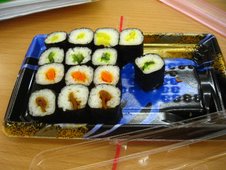
Veg Sushi Rolls: Many varieties of vegetable sushi rolls are available. I like kanpyo the best (brown strips of marinated gourd--be careful there is a popular fish variety that is also brown and looks very similar. I always have to double check and make sure I know what I'm getting) but cucumber (kyuri), carrot (ninjin), daikon, and natto are also available.

Yasai Tempura: Delicious battered and deep-fried vegetables. Sometimes homemade tempura batter contains eggs but the variety sold (usually serve-yourself style) at most grocery stores tends to be vegan. Ask to be sure. Tempura is best when eaten with a bit of macha salt. Satsumaimo (Japanese sweet potato) and kabocha (pumpkin) varieties are my favourite!

Natto: Fermented soy beans. This stuff is sticky, foul smelling, and gross. Most foreigners don't like it but give it a try, you might be one of the rare ones who can stomach it and come back for seconds. Natto is apparently very healthy and stand alone is vegan. Watch out when it's served as it can be mixed with fish seasoning.

If you're checking out a Japanese restaurant (never my choice) you can't go wrong with plain white rice or salad with no dressing. Those are about the only things you can't go wrong with. Sometimes tsukemono (pickled foods) are ok but be sure to ask about katsuo who not infrequently makes an appearance in the brine.

Anpan: This is that white bun looking thing you see in a heating rack at the cash register of the conbinis. They come filled all kinds of things and only the an one is vegan. It's a bit strange and very hot! But sometimes good, especially if you're stuck.

Now on to my favourite part of Japanese cuisine: DESSERT!
Many sweets in Japan are made from rice flour and mashed sweetened beans so there are a LOT of vegan options on this front. Some of my personal favourites include:

Daifuku: Round cakes of rice flour (mochi) filled with sweetened adzuki bean paste (anko). These come in many colours and flavours, including plain white, strawberry pink, and yomogi (or grass) green. I like the yomogi ones the best all year round but in strawberry season, my favourite treat is one of the strawberry variety with a fresh, juicy strawberry in the very center!

Andama: Hard to find, but recently these are my favourite. Brownish purple balls made of anko that are a little hard and covered with a sugar frosting.

Karinto: Deep fried black sugar cookies. About the size and shape of your finger. They also come in a white sugar variety.

Jelly Cups: Often these tiny cups filled with a jello-like dessert are made from konnyaku, not gelatin. They come in many varieties and flavours. Check the label, if you see "ゼラチン" they're not vegan!

Anko Popsicles: I see these popsicles everywhere! They come in a red box or package and show a pink popsicle with red beans in it. They look a bit milky but, yup! they're vegan! There's also a mango popsicle I've seen with bits of konnyaku in it. There are also usually some sherbets or sorbets floating about that are vegan too. Check the labels you might find a summer treat in the freezer case! I have never seen the mythical IV soy ice cream I heard about from the Vegan Ronin. For 2 years I have looked in every freezer case I have come across, but if you can find it, try it! Let me know how it is!

Dango: Dango just means mochi ball served on a skewer and these come with a few different coatings or toppings. Maybe the most common is mitarashi dango with a delicious sweet soy sauce based glaze.

Experiment and let me know what you think!

Saturday, June 7, 2008

Vegan Protein Shakes

I found a vegan protein shake! There's only one I can find among the wall of whey powders and it only comes in one flavour (orange) but it's something at least!

It's "SAVAS Aqua Soy Protein" and cost me about 3000 yen for 330 g. 14-21 g per shake. A 3 scoop shake (21 g) is about 67 Cal and 14 g protein in every shake. Even if you're not training for anything but want to boost your protein, it's not a bad idea!

Tuesday, June 3, 2008

Vegan Marathoning

I’m currently training for my first marathon and have been looking for tips for vegans. Most of the forums and sites I’ve found have just been discussing the regular issues of marathon training. I’m left to think that vegan training is no different but without specialized products that cater to us or vegan meal plans, I don’t think it’s the same at all. I intend to post on here any tips or products I find that are specifically vegan and also to post any advice I find or have on what to eat as well.

All marathon trainers recommend replenishing your body’s protein stores as soon as possible after every run to help repair muscle damage and prevent soreness and injury. Most sites I’ve seen stress that the first 15-30 minutes after a run is the optimal time for protein absorption and that, following a run, the first thing you should do is wolf down some high-protein energy bar or shake. I finally found a Vegan Protein shake (SAVAS Aqua Soy Protein--see post).

So far I have developed the habit of eating a can of minced seitan (Saniku’s “Gluten Burger”) mixed with ½ Tbsp of ketchup and ½ Tbsp of sweet chili sauce (just for a bit of flavour) and accompanied by a glass of V8 juice (from Costco) with a tsp of spirulina mixed in (ordered from home). This power lunch seems to be doing a great job of keeping my body energized and free from pain.


Today’s post-running meal was even simpler than the one above. I just took a block of tofu, pressed out some of the water, put it in a bowl, and added a swipe of ginger paste and about 1-2 Tbsp of ½ sodium soy sauce. It’s a delicious, high-protein, low-calorie, quick, filling, easy snack.


One of the obstacles I have faced with vegan protein sources is that they tend to also be high in calories. I am hoping to lose weight (or at least not gain) while doing this training and so have compiled a little chart of my favourite vegan protein sources as arranged by calories per gram of protein and yen per gram of protein (I know, I’m an excel nerd, what can I say). Let me know what you think…

Calories/gramYen/gram
Soy Protein Shake 4.79FD Tofu 2.1
Gluten Meat 6.23 Tofu4.1
Gluten Burger10.12 Soybeans5.5
FD Tofu10.14 Kidney Beans 7.5
Tofu 10.90 Gluten Burger 8.7
Tempeh 12.23 Mixed Beans 8.7
Mixed Beans 12.88 Chickpeas 9.8
Soybeans 13.33 Gluten Meat 11.2
Kidney Beans 14.98 Tempeh 13.0
Chickpeas 19.02 Protein Shake 13.64

Vegan Protein in Japan

How To Be A Healthy Vegan In Japan:

Protein たんぱく質

For the spoiled vegan used to meat analogs and vegan TV dinners, how do we still get all the nutrients we need with a whole food, from scratch diet? Here are a few suggestions on how to meet your daily intake goals with quick, easy, and available foods.

*Note: totals listed in the charts below may vary depending on brands, etc. Check labels to make sure how much you’re getting.*

The usual Daily Recommended Intake of protein is 0.8 g per kilo of body weight. http://www.vrg.org/nutrition/protein.htm states that some allowances may need to be made for the differences in absorption between plant and animal proteins. To be on the safe side, vegans should consume somewhere between 0.8 and 1 gram of protein per kilogram of body weight per day.

Of course the most obvious and economical sources of protein in Japan come from soy, in its many forms. In addition to regular, run of the mill tofu, other soy products include:
Abura age (あぶらあげdeep fried tofu pockets)
Agedoufu (揚げ豆腐deep fried blocks of tofu)
Koyadoufu (高野豆腐freeze dried tofu blocks about 100 yen/5 pack)
Okara (おから the pulped skins of the soy beans left over when making tofu, VERY cheap, throw a handful into whatever you’re making, also good for baking)
Yuba (湯葉 the hardened skin that forms on top when making soy milk, very delicate and not so cheap but can be tasty)
and the infamous
Natto (納豆smelly, sticky fermented soy beans that are hated by the majority of foreigners and the wise people of Osaka-fu).

The most widely used and cheapest seeds are sesame seeds (ごま). Adding a handful to whatever you’re cooking is a great way to increase your protein intake. Make sure you grind them slightly or chew them well to release their nutrients.

There are also some specialized products you can find at health food stores here, though not nearly as many as at home. Most health food stores sell dried unflavoured textured vegetable protein (TVP), tempeh, and gluten “meats” (seitan). Red and green lentils and some less common (in Japan) beans (like chickpeas) are also available at about four times what you’d pay back home.

Nuts are ridiculously expensive in Japan. Almonds are great sources of protein and calcium but cost about 300 yen for 100g. Cashews and pistachios are similarly expensive. Walnuts (くるみ)are very common and, of course, peanuts are cheapest and most widely available. Foreign stores, like Costco or ethnic import stores, are the only option for affordable nuts.

Beans are usually quite expensive in Japan. Canned beans and a few varieties of dried beans (soy) are available at Supermarkets. Legumes such as red and green lentils are also available but cost a lot. A large percentage of Japanese immigrants come from South America, especially Brazil and Peru. Depending on the area in which you live, there may be import or ethnic food stores that are an excellent, cheap sources of dried lentils and beans. If these stores aren’t available where you live, check out a Costco near you.

My favourite way to get protein is with a few traditional bean sweets. Adzuki beans (mashed into sweet red bean paste or anko) feature heavily in this category of Japanese desserts. While the mochi variety are usually vegan, always check for eggs and milk kanji. The wafer-looking shapes (usually patterened circles or fish) filled with anko are also delicious and usually vegan.

In the bean sweets category I have to digress a moment to include a recommendation of my absolute favourites. Those are kurodama (black sugar and edamame balls, available only in Kofu, Yamanashi), yomogi mochi or kusa mochi (green, made from a grassy weed that is very healthy), and ichigo daifuku (mochi filled with anko with one ripe strawberry in the middle, available only in strawberry season).

Whole grains like buckwheat noodles (soba), oats (available at health food stores and Costco), and quinoa (health food stores) also contain significant levels of protein.

Totals in the chart below are mostly taken from products I use personally; nutritional information will vary according to brand. The beans’ totals are from the brand available at Costco. Inari age is abura age that has been seasoned with soy sauce and sugar, ready for making inari sushi pockets. Nutritional information on inari age varies widely! The brand listed here is the cheapest available in my city…

Protein/100g
Freeze-dried tofu 51.8
Lentils 28.0
Peanuts 26.2
sesame seeds 22.5
Almonds 21.3
Pistachios 21.2
Tempeh 18.8
Saniku gluten meat 17.5
Saniku gluten burger 16.9
Oats 16.8
Soba 15.8
Cashews 15.3
Walnuts 15.2
Soybeans 14.7
Edamame 13.0
inari age 12.5
Miso 11.8
Mixed beans 9.2
kidney beans 10.7
Chickpeas 8.2
Tofu 6.6
inari age 12.5
agedoufu
yuba
Okara 4.8
natto
Anko 13
Anko no kimo 10

Vegan Calcium in Japan

How To Be A Healthy Vegan In Japan:

Calcium カルシウム

Current daily recommended intakes specify at least 1000 mg calcium. Too much is better than too little! Personally, I take calcium supplements everyday and recommend everyone (vegan or not) do the same. These supplements are available as widely here as at home.

Sesame seeds are widely available and very cheap. Adding a handful to whatever you’re making is a great way to boost calcium levels.

Dried figs are also cheap and available at most vegetable stands and supermarkets.

Almonds are a great source of calcium but can be expensive here outside of foreign import stores.

Edamame as well as standard and black soy beans also contain a lot of calcium but that doesn’t seem to hold true once they are processed. Tofu here is not usually packed in calcium sulfate and calcium levels are usually low (for some reason my freeze-dried tofu seems to be high in calcium).

Unlike Western soy milk, Japanese soy milk contains minute levels of calcium, often contains milk products (so be careful!), and is not very tasty (as it doesn’t usually contain sugar or other additives). Eden Soy and Kirkland brand fortified soy milks are available at health food stores and Costco. Rice Dream is also sometimes available but is not a significant source of calcium.

Other milk analogs like soy yogurt, soy ice cream, soy sour cream, and soy cream cheese, are not available at all. I have seen soy cheeses (and almond cheese) but these always contain casein and are thus not vegan.

Most leafy greens like kale, collards, and Swiss chard are not available here either. Spinach seems to be the only exception.

Calcium/100g

sesame seeds 718
freeze-dried tofu (5 blocks) 482
soybeans 277
almonds 248
edamame 197
garlic 181
raw kelp 168
raw wakame 150
dried figs 144
wasabi root 128
spinach 99
tempeh 95
oats 54
soy milk 4

Sunday, August 12, 2007

A few new finds

Here are some interesting new things I found at local shops:


This is a watery gelly-like dessert. You get the liquid with the konniyaku strips in it and a separate packet of sweeteners/flavours. You pour the sweetener into the water and enjoy. It was a big strange actually with a very gelly-like texture and VERY sweet (but you can adjust that depending on how much of the black stuff you put in). Overall, not bad. I would get it again if I were in a pinch.


I was in a regular old grocery store yesterday and found vegan belgian chocolate! made with rice milk and marketed as Lactose Free. Look for it in your town too!


Soyatoo's Soya Schlag Creme (Topping Cream) was a wonderful discovery. This was at my local health food store and so delicious. You just have to whip it a bit in a bowl before serving. It says to use an electric mixer but I just used a fork for a minute or so and it worked fine.


The Vegan Ronin gave me a tip for a vegan ice cream available outside health food stores. It is called IV and they have a line with 5 different flavours including black sesame, mango banana, and maple vanilla. mmmm... Check out their website here.

Friday, January 12, 2007

Japanese Cooking Glossary

Traditional Japanse cooking does not use an oven. For this reason, most Japanese houses and apartments (including mine) do not have an oven. This has been a difficult adjustment for me.

Certain ingredients common in many cooking styles around the world are not used in Japanese cooking and thus not available anywhere in Japan. The one I have had to omit the most in all the non-Japanese recipes I have made here is coriander (or cilantro). It is available dried at larger grocery stores and foreign import stores but I have yet to see it fresh anywhere in the country.

Abura Age (あぶらあご): Deep-fried tofu pockets that are very versatile. They can be boiled in soy sauce and sugar and filled with sushi rice to make inari sushi (see inari age below). They can also be added to soups and stews and almost anything else for a boost of deep-fried protein. They should be rinced in boiling water before use to make them a bit less oily. Age (pronounced ah-gay) means deep-fried in Japanese.

Daikon (だいこん): Tranlated as long radish, daikon is a huge white root with a green top. Grated, it is often used as a garnish. It helps with digestion and so after meals, it is often eaten just boiled in a soy sauce broth. This is a tasty vegetable but I don't buy it anymore because it stinks up the fridge, especially if refrigerated cooked.

Gobo (ごぼ): Translated as burdock root, this is a root that grows in many countries but is only eaten in Japan (as far as I know). You should always peel it and soak it in water for 5 minutes before cooking. I have no idea why. This vegetable is really slimy and slippery to work with when it is raw but is really tasty (and no longer slimy at all) when cooked.

Inari Age (いなり あげ): These are abura age pockets that have already been prepared for making inari by being seasoned with soy sauce and sugar in a perfect ratio. They are usually only around 100 or 200 yen for 10 and make cooking inari SO much easier. Not sure if these are available overseas.

Koji (こうじ): Soybeans (intentionally) infected with mold. It’s sold in supermarkets and looks kind of like tempeh. It’s not tempeh! It’s used in making homemade sake, mirin, and natto.

Mirin (みりん): is essentially a sweet cooking sake. It is available in the soy sauce/rice vinegar section of grocery stores in Japan and is probably available at Asian grocery stores overseas as well. It can be substituted with regular sake and a bit of sugar or just sugar and water.

Negi (ねぎ): Translated as welsh onion, negi is basically a huge scallion (or spring onion) with a stronger flavour. In size they are about halfway between a scallion and a leek but the the flavour and texture are definitely closer to scallion. It can be replaced by almost any members of the onion family.

Okara (おから): The bran of soy beans filtered out of the soy milk in the process of making tofu. It is bland but very nutrious and has the texture of desiccated coconut. You can get it from supermarkets and tofu shops. It is very cheap and I have even of stores where you get it free with purchase of tofu. Apparently it is a good base for veggieburgers.

Renkon (れんこん): Translated as lotus root, renkon is a circular root with tube-like holes inside extending the whole lenth of the root. It therefore has a very strange look when it is cut. Renkon should be boiled in water with a bit of vinegar to keep it from turning blue when you cook it. I don't really like renkon because it never really seems cooked. It is always crisp and tastes raw.

Soba (そば): This is simply buckwheat. It is most commonly seen in its noodle form which can be purchased fresh, hard, or even pre-cooked. The noodles are very tasty, healthy, cheap, and widely available. Soba can also be made into a tea (sold hot or cold), flour, etc.

Yuba(ゆば): The skin that forms on the top when boiling down soymilk. Widely available although sometimes can be expensive. Many and varied cooking applications.

Saturday, December 30, 2006

Phrases for Eating Out

I have been here for four months and (except for veg restaurants in tokyo) have only eaten at one restaurant--a sushi place where the owner speaks English. I think it is hard enough to make my dietary needs understood at home in English. (It never seems to dawn on people that butter is a dairy product or that that little peice of pork in the broth will matter.) I mostly rely on grocery store/conbini bentos (where I can read the ingredients) and cooking for myself at home.
However, I am posting this list to help any of you who are brave enough to try eating at regular (ie. not veg) restaurants in Japan:

~I don't eat meat: "niku o tabemasen"
~I don't eat fish: "sakana o tabemasen"
~I don't eat eggs: "tamago o tabemasen"
~I don't eat milk: "gyunyu o tabemasen"
~I don't eat honey: "hachimitsu o tabemasen"
~I don't eat meat, fish, eggs, milk, or honey: "niku to sakana to tamago to gyunyu to hachimistu o tabemasen"
~I don't eat any animal products: "doubutsu sei no mono wa subete tabemasen"

~Do you have any vegetarian dishes?: "bejitarian no ryori ga arimasu ka?"
~What kind of stock is in this soup?: "kono suupu no dashi wa nan desu ka?"
~Does this have __________ in it?: "kore wa __________ ga haitte imasu ka?"
~Does this dish contain meat?: "kono ryori ni niku ga haitte imasu ka?"

~What kind of oil do you use?: "abura wa nani o tsukatte imasu ka?"
~Do you use animal fat?: "doubutsu sei abura o tsukatte imasu ka?"
~Do you use vegetable oil?: "shokubutsu sei abura o tsukatte imasu ka?"

The phrase "watashi wa bejitarian desu" (I am a vegetarian) has not been nearly as useful as I was promised. Everytime I try to make myself understood using this phrase, it leads only to confusion and I am forced to resort to saying simply "I don't eat meat." It's possible that this one "watashi wa saishokushugi desu" (which means I am a vegetarian based on beliefs and refers historically to Buddhism) would be more familiar to people but I have never been able to remember it and find it easier to just list what things I don't eat. Besides, in Japan "vegetarians" almost always eat fish.

Reading Labels in Kanji!

Japanese has three writing systems--Hiragana, Katakana, and Kanji (Chinese characters)Katakana is used primarily for writing foreign loan words. It can take a matter of a few days to learn to read and write both of these. The following is a good website for a basic introduction to Hiragana and Katakana: Yoshida Institute.

Kanji, on the other hand, takes years to learn well enough to read and write adequately. There are over 50,000 kanji, 2,000 of which are considered everyday kanji which are necessary to complete such basic tasks as reading the newspaper.

Here are the essential kanji to remember to facilitate vegetarian eating in Japan.

kanji pronounciation: meaning

原材料名 gensairyoumei: ingredients
On food products, this kanji will show you where you should be looking for the following kanji:


肉  niku: meat
牛  ushi: cow
牛肉  gyu-niku: beef
豚  buta: pig
豚肉  buta-niku: pork
鶏  tori: chicken
鶏肉   tori-niku: chicken
鳥 tori: bird or poultry
鴨  kamo: duck
加工油脂 kakouyushi: processed oil. The worry here is that there's no way to tell what kind of oil (animal or vegetable) has been processed.

魚  sakana: fish If this kanji appears as part of another kanji, it usually represents a particular kind of fish--carp (鯉), tuna (鮪), etc.
魚介 gyokai: seafood, fish and/or shellfish products
蟹  kani: crab
海老  ebi: shrimp
貝  kai: shell fish
烏賊 いか or イカ ika: squid
蛸  tako: octopus
鰹 かつお or カツオ katsuo: bonito flakes from dried fish—used in stock in all soups that otherwise appear vegetarian.

卵  tamago: egg
玉子 tamago: egg

牛乳  gyunyu: milk
乳製品 nyu-seihin: dairy products

Be wary of the 乳 kanji. It means the ingredient is milk or a milk derivative, except in these two combinations: 豆乳 (soy milk) and 乳化剤 (lecithin--usually, if not always, from soy).

(蜂)蜜 (hachi)mitsu: honey
毛 ke: wool
絹 kinu: silk
革 kawa: skin, pelt, leather

貝類エキス kairui ekisu: shellfish extract
肝エキス kimo ekisu: liver extract
牛肉エキス gyuniku ekisu: beef extract
魚のエキス sakana no ekisu: fish extract
食肉エキス shokuniku ekisu: meat extract

Here are some kanjì you might see on vegan foods (these are ok!):

野菜  yasai: vegetables
大豆  daizu: soy bean
豆乳  tonyu: soy milk
豆腐  tofu: tofu

If you are expecting to come to Japan and read labels, you must learn to read at least katakana. Even though there is a kanji for toriniku often it will be written as チキン (chikin) in katakana, similarly you may see タコ or たこ for tako.

Other katakana to look out for include:
Anything that could possibly be pronounced as gelatin (ゼラチン is most common, but I have seen others),
ショートニグ (shortening—often animal derived),
マーガリン (margarine-may contain animal ingredients),
バタ (butter),
ラード (lard)

If you don't recognize a word written in katakana, always make sure you read it in every possible pronunciation. Keep in mind that words are rendered in katakana according to pronunciation and not English spelling. Use your imagination!!